Grades P-1 and 2-3 Teaching Supports
Wela'liek/Thank you for observing Orange Shirt Day and the National Day for Truth and Reconciliation.
Discussing the residential school system may evoke emotional responses from both students and
teachers. It is important that the cognitive and emotional development of your students be considered
and respected when choosing resources and information to be shared. As a support, we suggest the
following:
Suggested Support Actions:
- connect with your principal to discuss a home communication that reminds families about Orange Shirt Day and that student will continue to grow their learning about residential school, the trauma they caused, and the resilience of the Mi'kmaw people
- preview/pre-read all student resources and videos with colleagues who teach the same grade level to determine content that's an appropriate match for your students
- connect with a Mi'kmaw/Indigenous Student Support Worker, if one is part of your school's staff, to chat about your intended plans and to invite their guidance and suggestions
- allow multiple opportunities for students to talk about their thoughts and feelings
- learn along with your students, letting them know that these important truths were not previously taught in school programs and that you may have to do research together.
If you have questions or comments, please reach out to your region's Mi'kmaw Education Coordinator or email Mi'kmaw Services Branch at MIKMAQSERVICES@novascotia.ca.
Again, wela'liek/thank you for your participation and commitment to Truth and Reconciliation, actively ensuring that 'Every Child Matters'.
Select a Focus Area:
Kindness: Context for Teachers
Refer to the following folders in Mi'Kmaw Services Branch to support building your own knowledge about the residential school system in Canada and about Shubenacadie Residential School in Nova Scotia:
- Messages from Mi'kmaw Services Branch, NS EECD
- Info about Orange Shirt Day l National Day for Truth and Reconciliation
- For Teachers Info About Residential Schools including Shubenacadie Residential School
Kindness: Mi'kmaw Teachings
It is important to be kind to each other, to the Earth and all living things, and to ourselves; kindness is an expression of love and comes in different forms. We can feel kindness and love, and we can also act in ways that show kindness and love.
Kindness: For Teachers
Become familiar with the following books from the Antle aq Witapk Treaty Education Series: Antle Loves his Antlers and Pikto'l Learns the Ko'jua. These books were created for P–2 classrooms to help bring awareness and greater understanding of Mi'kmaw teachings and perspectives. They include examples of kindness and love through different actions.
Kindness: Suggested Learning Experience
- What does it mean to be kind?
- Who is someone who is kind to you? How does that person show kindness to you?
- Tell me a way you have been kind to someone in your family? In your community or neighbourhood? In our classroom? On the schoolgrounds or the bus?
- How does it feel when someone is kind to you? How do you feel when you are kind to someone?
- What does love mean?
- How does someone show love? How does it feel when someone shows they love you?
- How do you show love? How does a pet show love?
- For example, in Antle Loves His Antlers, Niskamij only wants good things for Antle. When we love someone, we want to make sure that they feel safe and protected.
- In Pikto'l Learns the Ko'jua, the elder shows kindness when he gives Pikto'l the jigmagn as a gift for his hard work learning the new dance.
- Sometimes we have to be an example and show others how to be kind.
- When we are kind to someone, it can change their day.
- Why is it important to be kind?
- Phyllis is an Indigenous person who went to school, far away from her home when she was a little girl. Phyllis did not get a lot of kindness and love shown to her there.
- Compare this to Antle and Pikto'l who both have family and community members close to them who show them kindness and love.
Kindness: Follow-up Activities & Discussion
- Invite conversation, asking why students chose the scenarios for their puppets.
- Therefore, on September 30th, we wear orange shirts to remember all the children like Phyllis––we remember that Every Child Matters.
- Wearing orange on Orange Shirt Day is a symbol of the importance of being kind and choosing to speak and act in ways that show kindness and love.
When We Were Alone: Context for Teachers
When We Were Alone When a young girl helps tend to her grandmother's garden, she begins to notice things about her grandmother that make her curious. Why does her grandmother have long braided hair and wear beautifully coloured clothing? Why does she speak another language and spend so much time with her family? As she asks her grandmother about these things, she is told about life in a residential school a long time ago, where everything was taken away. When We Were Alone is a story about a difficult time in history and, ultimately, a story of empowerment and strength. Refer to the following folders
Mi'kmaw EECD Courses to support building your own knowledge about the residential school system in Canada and about Shubenacadie Residential School in Nova Scotia:
When We Were Alone: For Teachers
Teaching Difficult Subjects with "When We Were Alone"
When We Were Alone: Suggested Learning Experience
- What makes you happy? What makes you sad?
- Think of something very special to you. It may be a favourite toy or “stuffie” or a gift that someone gave to you. How would you feel if you lost that favourite thing? How would you feel if someone took it from you and kept it, never giving it back to you?
- Take time with each page to explore the illustrations and talk about what is happening.
- Talk about the relationship between the grandmother and grandchild. Invite students to comment about this relationship or their own relationship with a special family member.
- Open conversation to talk about each of the cultural teachings that the grandmother remembers losing at the school. Ask students why they think it was important to her to find ways to remember these practices when she and other students were alone at the school.
- Ask students questions such as:
- What is your favourite special activity that the grandmother did as a young girl at the school and why?
- How might the grandmother have felt when each special thing was taken from her? How would you feel if this happened to you?
- What might have happened if the grandmother had fully lost some of these special practices? How would it make her feel?
- How would other people in her family and community feel if she came back home and had forgotten these special practices? How might they help her get them back?
When We Were Alone: Follow-up Activities & Discussion
Phyllis's Story: Context for Teachers
Mi'kmaw EECD Courses to support building your own knowledge about the residential school system in Canada and about Shubenacadie Residential School in Nova Scotia:
One residential school was St. Joseph's Mission in Williams Lake, British Columbia. It was operated by the Roman Catholic Church from 1890 to 1981 and, as with all residential schools, was funded by the Canadian government. The school was at its busiest in the 1950s when it had roughly 300 students from the surrounding fifteen First Nations in the region. Parental visits were not allowed during the school year, and students were allowed to return home for one month of the year only.
As part of a residential school commemoration project in May 2013, former student, Phyllis Webstad, told the story of her first day at St. Joseph's, as a six-year-old girl. She vividly recalled that her shiny, new orange shirt, bought by her grandmother, had been taken from her soon after she arrived at the school. Her story prompted the realization that many residential school survivors have similar stories of loss—loss of belongings, cultural traditions and language, family and loved ones, and self-identity. Orange Shirt Day was created as an opportunity for others to remember those young students who lost so much through the residential school system, including over 3000 children who experienced the ultimate loss, that being loss of life. (NOTE: More recent sources estimate the number of deaths at over 6000.)
Phyllis's Story: Context for Students
Using child-friendly language and being mindful to exclude details that are not age-appropriate, help students form a basis of knowledge about residential schools. It may help to show a map of Nova Scotia to explain the locations of the Shubenacadie Residential School and the First Nations communities in Nova Scotia, New Brunswick, and Prince Edward Island from which children came to attend the school. Many traveled long distances by train, leaving their families, homes, and communities. You may also want to show a photo of the school.
In order to help students gain a basic understanding of the negative effects attending residential school had on Indigenous children, it is important to find ways to use the experiences of your students to build connections. Phyllis's story of her first day of school is one which most students can relate to on some level (nervousness, excitement, fear, etc.). Most children also can relate to the loss of something that is important to them. Using student experiences as a basis of the discussion about Phyllis's story will provide them with a platform from which they can begin to build a deeper understanding about the sense of loss experienced by residential school students.
Phyllis's Story: Pre-Teaching Vocabulary
The Mission: As it is used in Phyllis's story, “the Mission” is the shortened name for St. Joseph's Mission Residential School.
Phyllis's Story: Suggested Learning Experiences
- You may prefer to share Phyllis's Orange Shirt, a picture book for young learners.
- The following discussion starters may be helpful:
- Have students turn to a partner and retell Phyllis's story using their own words.
- Even though Phyllis's family did not have much money, her grandmother made sure to buy Phyllis something special to wear on her first day of school. Why do you think her grandmother did that?
- Why do you think the people in charge at the residential school took Phyllis's shirt from her? How do you think that made Phyllis feel and why?
- What effect did attending residential school have on Phyllis?
- Think of one word that describes Phyllis's character based on what you have learned about her. Explain your choice.
- In a sharing circle, have students share their illustrations or graphic story and tell how they feel about what they've learned.
Phyllis's Story: Follow-up Activities and Discussion
Stories of Resilience: Context for Teachers
Refer to the following folders in Mi'kmaw EECD Courses to support building your own knowledge about the residential school system in Canada and about Shubenacadie Residential School in Nova Scotia:
The learning experiences and resources referenced here build on the key concepts of resilience. Plan to present ways in which students can strengthen their understanding of this concept and its connection to the residential school experience.
Stories of Resilience: Context for Students
Using child-friendly language and being mindful to exclude details that are not age-appropriate, help students form a basis of knowledge about residential schools. It may help to show a map of Nova Scotia to explain the locations of the Shubenacadie Residential School and the First Nations communities in Nova Scotia, New Brunswick, Prince Edward Island, and the Gaspé Region of Quebec from which children came to attend the school. Many traveled long distances by train, leaving their families, homes, and communities. You may also want to show a photo of the school.
Suggested Learning Experience: Two Stories of Resilience
Have conversations that help students fully grasp the concept of resilience and its connection to the residential school experience.
- What is resilience?
- Ask students what resilience means to them or offer the meaning and have them put it in their own words.
- Invite them to talk about current or past examples of people who demonstrated resilience or challenging circumstances that would then require resilience.
- Discuss the meaning of resilience in the residential school context: The ability to overcome fear, sadness, loneliness, loss, and unkindness; to persevere and maintain cultural teachings and identity.
The stories of two Indigenous survivors are presented below: When We Were Alone, which children might be familiar with from an earlier grade, and Phyllis Googoo & the Ladybugs. Each is a story of a young girl at a residential school... Both had parts of who they were taken from them by the teachers at the schools. As young resilient girls, they creatively found ways to remember and keep safe parts of who they were, parts of home.
When We Were Alone Summary
When a young girl helps tend to her grandmother's garden, she begins to notice things about her grandmother that make her curious. Why does her grandmother have long braided hair and wear beautifully coloured clothing? Why does she speak another language and spend so much time with her family? As she asks her grandmother about these things, she is told about life in a residential school a long time ago, where everything was taken away. When We Were Alone is a story about a difficult time in history and, ultimately, a story of empowerment and strength.
Resilience: For Teachers
- A read-aloud recording of When We Were Alone, with Mi'kmaw translations for the Cree text, can be accessed at When We Were Alone: Mi'kmaw translations
Grandmother Turtle: Context
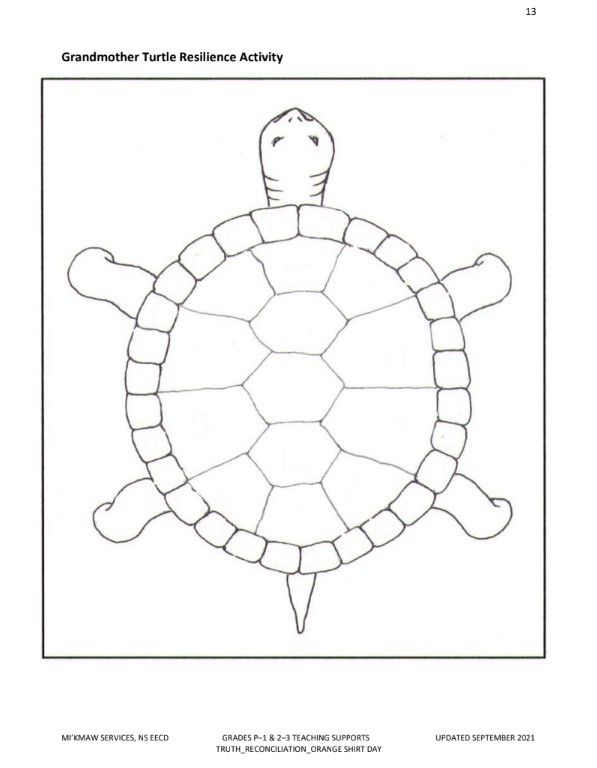
The Grandmother Turtle teaches the truth according to the Seven Sacred Teachings. The turtle is a great example of resilience because it has been around since the time of the dinosaurs and continues to thrive today.
Grandmother Turtle: Activity
Using the Grandmother Turtle Shell Template, engage students in a collaborative activity.
Classroom Walk-about: During this activity, have students write positive traits, virtues, strengths, and talents that their peers embody within the sections of each other’s turtle shells.
Note: This resource is intended for printing and distribution to students.
National Day for Truth and Reconciliation
Since 2013, September 30th has been observed as Orange Shirt Day, a phrase coined because of Phyllis
Webstad, a survivor of St. Joseph Mission Residential School in British Columbia, having had her new orange
shirt bought by her grandmother taken from her when she arrived at the school. It has become a symbol of
the personal stories of the tens of thousands of Indigenous children taken from their families and
communities, thousands of whom never were to return home.
Phyllis Webstad Orange Shirt Day Presentation
Beginning in 2021, September 30th will also be known in Canada as the National Day for Truth and
Reconciliation. Its name speaks to the importance of two necessary commitments all Canadians must make:
to learn the truth about Canada's shared history with Indigenous peoples, including residential schools, and
to act in ways that nurture ongoing relationships of Reconciliation.

National Day for Truth & Reconciliation
Canadian Geographic: Behind National Day for Truth & Reconciliation