Grades 4-6 Teaching Supports
Wela'liek/Thank you for observing Orange Shirt Day and the National Day for Truth and Reconciliation.
Discussing the residential school system may evoke emotional responses from both students and
teachers. It is important that the cognitive and emotional development of your students be considered
and respected when choosing resources and information to be shared. As a support, we suggest the
following:
Suggested Support Actions:
- connect with your principal to discuss a home communication that reminds families about Orange Shirt Day and that student will continue to grow their learning about residential school, the trauma they caused, and the resilience of the Mi'kmaw people
- preview/pre-read all student resources and videos with colleagues who teach the same grade level to determine content that's an appropriate match for your students
- connect with a Mi'kmaw/Indigenous Student Support Worker, if one is part of your school's staff, to chat about your intended plans and to invite their guidance and suggestions
- allow multiple opportunities for students to talk about their thoughts and feelings
- learn along with your students, letting them know that these important truths were not previously taught in school programs and that you may have to do research together.
If you have questions or comments, please reach out to your region's Mi'kmaw Education Coordinator or email Mi'kmaw Services Branch at MIKMAQSERVICES@novascotia.ca.
Again, wela'liek/thank you for your participation and commitment to Truth and Reconciliation, actively ensuring that 'Every Child Matters'.
Select a Focus Area:
Identity: Context for Teachers
Refer to the following folders in this link (https://drive.google.com/drive/folders/137HJqN6MZU0GmAVY5mZQFKjeGoP43ECi) in support of building your own knowledge about the residential school system in Canada and about Shubenacadie Residential School in Nova Scotia:
- Messages from Mi'kmaw Services Branch, NS EECD
- For Teachers_Info About Residential Schools_including Shubenacadie Residential School
The learning experiences and resources referenced here build on the key concepts of identity and resilience. Plan to incorporate ways in which students can strengthen their understanding of these two concepts, their relationship to each other, and their connection to the residential school experience.
From birth to the end of our lives, we are continuously developing our personal identities. In addition to other factors, we build an identity based on our relationships with family, friends, community, language, geography, and other social factors. Identity plays a central role in healthy child development. When a child feels a strong sense of self and a secure sense of belonging to family, community, and peers, they develop a positive, healthy appreciation for who they are, and they are better able to deal with challenges and adversity. Healing Power of Cultural Identity
At Shubenacadie Residential School and other residential schools throughout Canada, Indigenous students were stripped of their identities. In fact, the taking of identity was one of the motives behind the Canadian government establishing residential schools: Our objective is to continue until there is not a single Indian in Canada that has not been absorbed into the body politic and there is no Indian question, and no Indian Department, that is the whole object of this Bill. – –––Dr. Duncan Campbell Scott, 1920 (Scott served with the federal government as the Deputy Superintendent of the Department of Indian Affairs from 1913–1932 and oversaw residential schools at the height of their operation.)
The moment Indigenous children stepped foot into residential schools, the assault on their identities began. This included having their names replaced with Euro-Canadian ones. Worse still, each student was assigned a number, and teachers would often refer to students only by their numbers. This is noted in a summary report released by the Truth and Reconciliation Commission. https://nationalpost.com/news/canada/assault-on-residential-school-students-identities-began-the- moment-they-stepped-inside
Identity: Context for Students
Using child-friendly language and being mindful to exclude details that are not age-appropriate, help students form a basis of knowledge about residential schools. It may help to show a map of Nova Scotia to explain the locations of the Shubenacadie Residential School, Mi'kmaw First Nation Communities in Nova Scotia, and Mi'kmaw and other First Nation Communities in New Brunswick, Prince Edward Island, and the Gaspé Region of Quebec from which children came to attend Shubenacadie Residential School. Many traveled long distances by train, leaving their families, homes, and communities. Refer to the fact sheet about Shubenacadie Residential School and show the school's photo found in https://drive.google.com/drive/folders/137HJqN6MZU0GmAVY5mZQFKjeGoP43ECi
Identity: Pre-teaching Vocabulary
- Resilience
- In this context, the ability for Indigenous peoples to persevere, survive, and overcome the ways in which the Canadian government and the residential school system caused harm, trauma, and ongoing challenges to children, their families and communities, and generations that followed. Synonyms: strength; resistance; survival
- Survivor
- In this context, an Indigenous person who attended residential school and lived through the experience.
- Residential school
- Schools to which Indigenous children were forced to go, leaving their homes, families, friends, and communities behind. These schools were funded by the Canadian government, and most were run by clergy (those who worked in churches). Indigenous children were forced to live according to the ways and beliefs of Euro-Canadians.
- Indian agent
- A representative of the Canadian government whose duties included removing Indigenous children from their families and making sure they stayed in the residential schools.
- Identity
- The way one sees themself and their position in the world around them.
- Reconciliation
- In this context, a positive relationship between Mi'kmaq and non-Mi'kmaw Canadians based on shared knowledge, understanding, and respect. Centuries ago, the Mi'kmaq and early English settlers to Mi'kma'ki signed Treaties of “Peace and Friendship,” which included living together in harmony. This relationship is respected when we can walk together, side by side with no one in front or behind the other.
Identity: Suggested Learning Experience
Have students sit in small groups to discuss “identity.” The following prompts may be helpful to spark conversation:
- What is meant by identity?
- Ask each student in the group to share what identity means to them, on a personal level.
- Invite students to talk about elements and characteristics that make up their individual identities.
- Discuss personality and identity.
- Ask students to describe a family member or friend's identity in comparison to their own.
- Share a definition of “identity” with the class and have each group re-write it in their own words and add to it to capture what identity means to them.
- Post this statement: “My name is an important part of my identity.”
- Ask students to discuss this in their groups and to be prepared to share one point they discussed.
Identity: Follow-up Options
Activity Options: Provide at least two of the following activities so students have a choice. Choice is important to offer in light of students who may not live with their family members or whose family may not know the origins of their name.
- Create Name Art: Create a piece of name art incorporating features of their identity in the visual, whether in the letters or surrounding it.
- Research the Significance of Your Name: As a home assignment, research the significance of your name.
- Students may talk with family members or search online to find the meaning of their name.
- The next day, students share their research in small groups and chat about the meaning behind and/or the significance of their name, its origin, etc.
- Explore the UN Convention on the Rights of the Child: Discuss this in light of what they've learned and discussed about one's identity and in reference to the residential school experience.
- Connect with Community Knowledge: Contact a Mi'kmaw Elder, Knowledge Keeper, your region's Mi'kmaw Education Coordinator, or a Student Support Worker to interview about the Mi'kmaw tradition of the naming ceremony. Connect what you've learned to the concept of identity.
Relationship Loss: Context for Teachers
Refer to the following folders in this link in support of building your own knowledge about the residential school system in Canada and about Shubenacadie Residential School in Nova Scotia:
- Messages from Mi'kmaw Services Branch, NS EECD
- For Teachers_Info About Residential Schools_including Shubenacadie Residential School
The learning experiences and resources referenced here build on the key concepts of identity and resilience. Plan to incorporate ways in which students can strengthen their understanding of these two concepts, their relationship to each other, and their connection to the residential school experience.
Understanding Loss and Intergenerational Trauma
The concept of loss when discussing residential schools is broad and deep: loss of language and culture; loss of identity; loss of parental relationships as well as familial connections. This profound loss and the trauma that ensued was carried across generations from survivors to their descendants and is known as intergenerational trauma. This can affect individuals and families, as well as communities.
It is important to recognize and acknowledge the resilience of the survivors of residential schools and their families, because their spirits never died despite the tremendous loss and abuse they suffered.
Relationship Loss: Additional Learning
Resources for Teachers
- INENDI: A CBC Short Docs Original (44m05s) – Sarain Fox interviews her Auntie Mary Bell, a survivor of residential schools.
- Stolen Children: Voices (18m35s) – CBC News interviews residential school survivors.
Resources for Students
- Lillian Elias: A Residential School Survivor's Story (1m42s) – Animated video.
Relationship Loss: Context for Students
Building Foundational Knowledge
When introducing this topic, use child-friendly language and be mindful to exclude details that are not age-appropriate.
It may be helpful to show a map of Nova Scotia to explain the locations of:
- The Shubenacadie Residential School.
- Mi'kmaw First Nation Communities in Nova Scotia.
- Mi'kmaw and other First Nation Communities in New Brunswick, Prince Edward Island, and the Gaspé Region of Quebec from which children came to attend the Shubenacadie Residential School.
Explain that many children traveled long distances by train, leaving their families, homes, and communities.
For additional resources, refer to the fact sheet about the Shubenacadie Residential School and view the school's photo at the Mi'kmaw Services Branch website.
Relationship Loss: Pre-teaching Vocabulary
- Resilience
- In this context, the ability for Indigenous peoples to persevere, survive, and overcome the ways in which the Canadian government and the residential school system caused harm, trauma, and ongoing challenges to children, their families and communities, and generations that followed. Synonyms: strength; resistance; survival
- Survivor
- In this context, an Indigenous person who attended residential school and lived through the experience.
- Residential school
- Schools to which Indigenous children were forced to go, leaving their homes, families, friends, and communities behind. They were funded by the Canadian government, and most were run by clergy (those who worked in churches). Indigenous children were forced to live according to the ways and beliefs of Euro-Canadians.
- Intergenerational trauma
- The effects of trauma suffered by an individual or groups carried on in future generations.
Relationship Loss: Suggested Learning Experience
Restoring Relationships as a Pathway to Reclaiming Identity
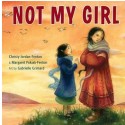
The sequel to When I Was Eight explores Olemaun's return to her Inuit community and the impact her time away had on her relationship with her mother and with her surroundings. Through love, patience, and understanding, these relationships are restored and Olemaun reclaims her identity.
Share with students the picture book Not My Girl by Christy Jordan-Fenton and Margaret Pokiak-Fenton.
Read it first fully through, without interruption. Then, ask students to talk within the small groups, allowing time for them to share their thoughts with each other.
Read the book aloud a second time, asking students to focus on Olemaun's experience returning home and the parts of her that were lost while she was at residential school.
In their small groups, encourage students to have meaningful conversation about this book and what they know about residential schools. The following prompts may be used to facilitate discussions:
- By analyzing the experiences Olemaun has when she returns home, identify the parts of her and her identity that were taken when she was at residential school.
- Loss of parental relationship, of connection with the land (hunting; gathering), of familiarity with environment (food, language, dress, and ways of being), and loss of self.
- How was Olemaun feeling when she first returned home and why? How do the author and the illustrator show this?
- Compare this to how you think Olemaun was feeling when her mother said, “Not my girl.”
- Why do you think that her mother reacted to Olemaun the way she did? Discuss what you think she meant by the words “Not my girl.”
- How might Olemaun's mother been feeling at that moment? Why do you think this?
- Discuss Olemaun's path to rediscovering and reclaiming her identity. When and why did she begin to feel again a sense of belonging? What helped restore her relationship with her mother, her surroundings, and herself?
Relationship Loss
Follow-Up Activity: Create a Bulletin Board or Wall Display
- With students sitting in a circle, invite thoughts and opinions as to how a child should feel at school and why. You may wish to repeat the question as applied to students of different ages.
- Give each student a copy of a paper eagle feather. You may choose to use coloured paper or have students colour their feather if made from white paper.
- Each student designs their feather using words or art to express how children should feel when they are at school.
- Cut the feathers out and display them as a class or do the same activity with multiple classes to create one larger visual display.
215+ Unearthed: Context for Teachers
Refer to the following folders in this link (https://drive.google.com/drive/folders/137HJqN6MZU0GmAVY5mZQFKjeGoP43ECi) in support of building your own knowledge about the residential school system in Canada and about Shubenacadie Residential School in Nova Scotia:
- Messages from Mi'kmaw Services Branch, NS EECD
- For Teachers_Info About Residential Schools_including Shubenacadie Residential School
The learning experiences and resources referenced here build on the key concepts of identity and resilience. Plan to incorporate ways in which students can strengthen their understanding of these two concepts, their relationship to each other, and their connection to the residential school experience.
In May 2021, the remains of 215 children were located on the site of the former Kamloops Residential School in British Columbia. As was known, this was not to be an isolated incident. The initial estimation was that 6000 children died during their time at the residential school, but that number continues to grow as thousands of unmarked graves were located over the following months. We know from survivors' accounts that more unmarked graves and children's remains will be recovered.
They Found Us, an illustration created by Whitney Gould of We'koqma'q First Nation, incorporates an eagle, traditionally the one animal that can soar to the spirit world, and an orange sunset to represent the spirits of the 215 children whose remains were located at the former site Kamloops Residential School in British Columbia, making their way to the spirit world. Powerful words, artwork shared by Cape Bretoners to raise awareness of residential schools reaches thousands | SaltWire
215+ Unearthed: Context for Students
Using child-friendly language and being mindful to exclude details that are not age-appropriate, help students form a basis of knowledge about residential schools. It may help to show a map of Nova Scotia to explain the locations of the Shubenacadie Residential School, Mi'kmaw First Nation Communities in Nova Scotia, and Mi'kmaw and other First Nation Communities in New Brunswick, Prince Edward Island, and the Gaspé Region of Quebec from which children came to attend Shubenacadie Residential School.
Many traveled long distances by train, leaving their families, homes, and communities. Refer to the fact sheet about Shubenacadie Residential School and show the school's photo found in https://drive.google.com/drive/folders/137HJqN6MZU0GmAVY5mZQFKjeGoP43ECi
It may also be helpful to include a map of the location residential schools across the country.
215+ Unearthed: Pre-teaching Vocabulary
- Resilience
-
in this context, the ability for Indigenous peoples to persevere, survive, and overcome the ways in which the Canadian government and the residential school system caused harm, trauma, and ongoing challenges to children, their families and communities, and generations that followed
Synonyms: strength; resistance; survival
- Survivor
- in this context, an Indigenous person who attended residential school and lived through the experience
- Residential School
- schools to which Indigenous children were forced to go, leaving their homes, families, friends, and communities behind. They were funded by the Canadian government, and most were run by clergy (those who worked in churches). Indigenous children were forced to live according to the ways and beliefs of Euro-Canadians.
215+ Unearthed: Suggested Learning Experience
They Found Us by Witney Gould
With students in small groups, share the following artwork created by Whitney Gould without saying its title They Found Us or discussing it. Use the prompts that follow to guide the group work.
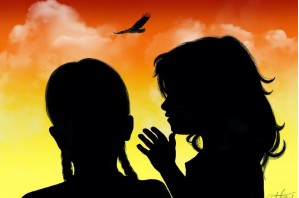
Have each small student group choose a question from below to respond to and discuss in relation to the artist's work. (The questions could be on separate pieces of paper and placed in a bag or container for each group to draw an unseen question.) Allow enough time for each group to discuss the question, form a response, and then share both the question and the response with the whole class.
- Describe what you see in this piece? What do you notice?
- What type of bird do you think is flying? What makes you think this? Why might the artist have drawn this bird in her artwork?
- The children appear to be talking. How does the artist show this?
- What do you think the children are saying to each other?
- Artists make deliberate choices of every detail they create in a piece of art.
- Why do you think Whitney Gould used the colours you see?
- Why do you think she chose to paint the children as silhouettes? What effect does this have?
- If you've seen this picture before, talk about where and what the circumstances were.
Following the class discussion, share the artist's title for her piece: They Found Us. Proceed to tell of the news release on May 28, 2021, of the initial detection of children's remains at the site of the former Kamloops Residential School in British Columbia. Inform the students that Ms. Gould's art piece was created in honour of the children whose remains were recovered in Kamloops.
NOTE: This will be a sensitive topic and ample time will be needed for discussion and questions.
Have the children return to their groups and discuss their same question and response a second time now knowing the name and intended purpose of the artwork and connecting to what they know about residential schools. Groups will share these “updates” with the whole class, inviting thoughts and comments from their classmates.
As a class, discuss the meaning behind the title They found us and why they think Ms. Gould chose this name for her piece.
215+ Unearthed: Suggested Learning Experience
215+ unearthed by Naomi Pierrard
View Poem: 215 Unearthed

Play the video recording of 215 unearthed written and shared by Mi'kmaw poet and song carrier Naomi Pierrard of We'koqma'q First Nation: Unearthed
First, play it uninterrupted then a second time asking students to listen carefully to the story being told.
Engage students in this interactive small group activity. Give each group a printed copy of 215 unearthed by Naomi Pierrard, found on a following page. Explain and do the activity one section at a time.
Section One
- Ask each group to re-read the poem and to underline 3 lines that stand out or resonate with them.
- Prepare for a class reading of the poem.
- As the teacher reads the title and the begins to read the poem, student groups join in when the 3 lines they underlined are to be read.
Section Two
- Student groups narrow their chosen lines further by selecting just 1 line.
- Prepare to re-read the poem, a final time.
- Students will join in when their line is to be read.
Whole Class Discussion:
- Facilitate whole class discussion regarding why each group selected the one line they last shared.
- Invite comment on those moments when groups chose the same line(s) to share.
- Why were those lines the ones selected by many groups?
- Discuss the message within this poem.
- Both 215 unearthed and They found us express thoughts associated with residential school. Compare the effectiveness of each medium.
- Discuss the connection the each of the poem and the artwork has to the key message about Orange Shirt Day: Every Child Matters.
Follow-Up Options
Students may create their own artwork behind the poem to further honour the children whose remains were located at the former Kamloops Residential School site.
National Day for Truth and Reconciliation
Since 2013, September 30th has been observed as Orange Shirt Day, a phrase coined because of Phyllis
Webstad, a survivor of St. Joseph Mission Residential School in British Columbia, having had her new orange
shirt bought by her grandmother taken from her when she arrived at the school. It has become a symbol of
the personal stories of the tens of thousands of Indigenous children taken from their families and
communities, thousands of whom never were to return home.
Phyllis Webstad Orange Shirt Day Presentation
Beginning in 2021, September 30th will also be known in Canada as the National Day for Truth and
Reconciliation. Its name speaks to the importance of two necessary commitments all Canadians must make:
to learn the truth about Canada's shared history with Indigenous peoples, including residential schools, and
to act in ways that nurture ongoing relationships of Reconciliation.

National Truth & Reconciliation
Canadian Geographic: Behind National Day for Truth & Reconciliation